|
History
of the Todmorden Unitarian Church
The church was built
between 1864 and 1869 at the behest of the three Fielden brothers,
sons of 'Honest John' Fielden, the reformist mill-owner and
Radical MP who steered the Ten Hours Act through Parliament in
1847. Fielden senior was of Quaker stock, but turned to Methodism
and was then persuaded to follow Joseph Cooke's breakaway brand of
Methodist Unitarianism, eventually becoming closely involved with
the sect's Todmorden chapel and giving generous help to the local
Unitarian community. But after his death in 1849, continuing
growth of that community made the chapel steadily less adequate,
and in 1864 his sons, by now very wealthy from the textile
business he had fostered, decided to provide a replacement
building, partly in honour of their father's memory.
Their plans went well beyond a mere enlarged meeting house, and
despite traditional Unitarian mistrust of show and ritual, the
brothers commisioned a building of considerable splendour, with
the original chapel eventually becoming a Sunday school.
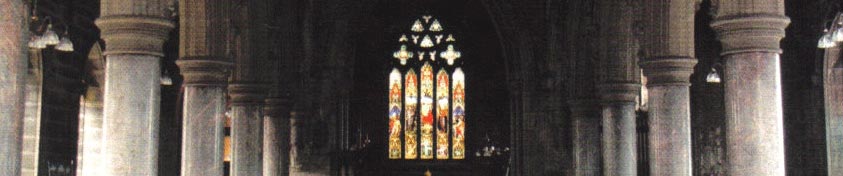
Modelled on 14th-century 'decorated Gothic' but built to an
Anglican pattern, and of size more suggestive of a small cathedral
than a nonconformist chapel (it comfortably seats over 500), the
church was designed by John Gibson, who had been a member of
Charles Barry's team at the Houses of Parliament. He had already
worked for the Fieldens and was responsible for Dobroyd Castle,
built concurrently with the church as a home for the middle
brother John. The two buildings were so positioned that each could
be viewed from the other across the intervening valley, while the
church's grandeur complemented by its imposing setting on a hill
overlooking the town, with a winding drive leading up to the
building from what might otherwise easily be mistaken for a
manorial gatehouse. Gibson's next big projects in Todmorden were
to be the quasi-Gothic Fielden School and the neo-classical Town
Hall, finished in 1872 and 1875.
On the church's opening day in April 1869 a congregation of 800
assembled to hear the inaugural sermon , delivered by the noted
Manchester Unitarian William Gaskell, widower of novelist
Elizabeth Gaskell. Perhaps aware of local unease at the buildin's
Gothic implications, Gaskell devoted part of his address to
arguing that despite Puritan inclinations to the contrary, there
is nothing wrong in employing art to enhance religion provided
this involves no compromise of inner sincerity. This endorsement
of their bold venture was no doubt very welcome to the Fieldens,
and whatever early heart-searchings there may have been regarding
the shift in style, the new church soon became much loved and
remained a thriving centre of the faith until well into the 20th
century. This sometimes irritated local Anglicans, especially in
the early days when the church's radical minister Lindsay Taplin
was inclined to be very outspoken in favour of Unitarianism's
liberal, non-trinitarian, humanistic outlook
At the start, the building and its grounds were the property of
the Fielden family, but in 1882 an endowment fund was established
to give the church a degree of independence. Yet as the years
slipped by there was an increasing shortage of funds to maintain
the building, and despite a great burst of activity in the
centenary year of 1969, it was finally closed in 1987, with
meetings then held in the lodge until 1992. Vandalism and decay
set in, but despite its Grade I listed status, various schemes
suggested for the church's preservation came to nothing. However,
with its acquisition by the Historic Chapels Trust in 1994, a
proper programme of repairs and renovation has been put in hand,
and while this proceeds a locally elected management committee
opens the building from time to time to stimulate interest and
facilitate study by school parties, historical and architectural
groups.
|